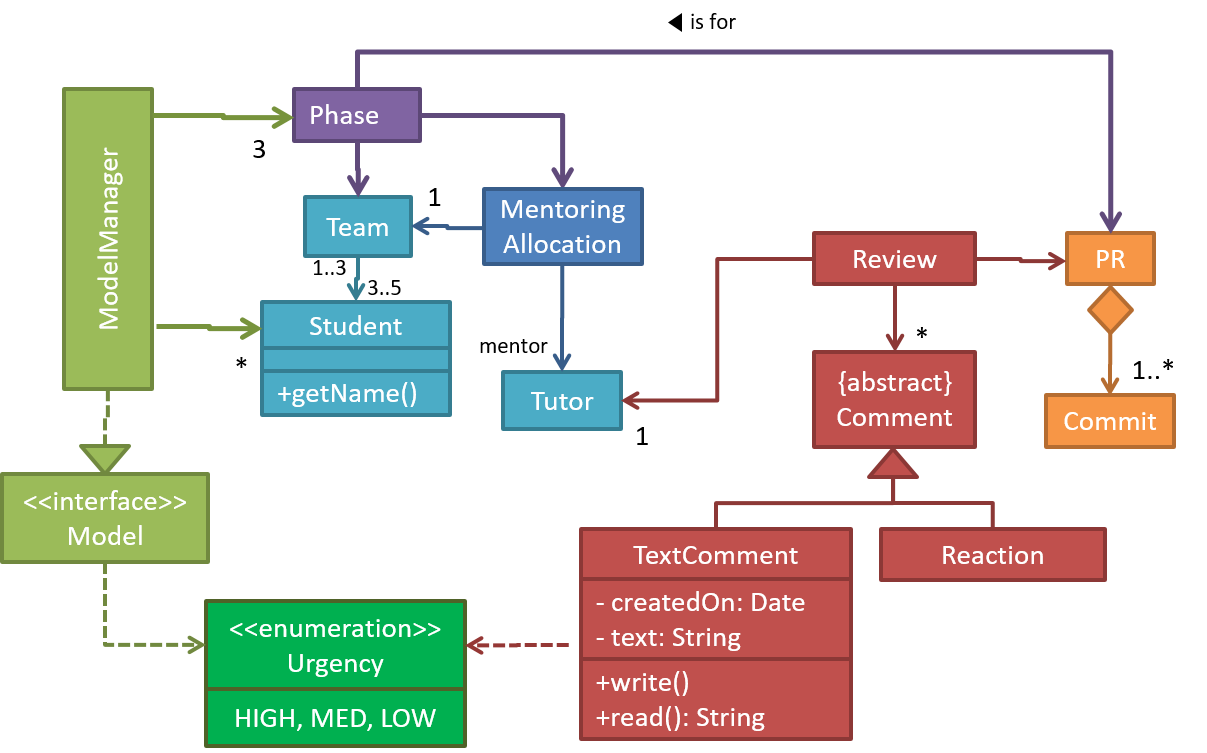
Can draw UML classes
The basic UML notations used to represent a class:
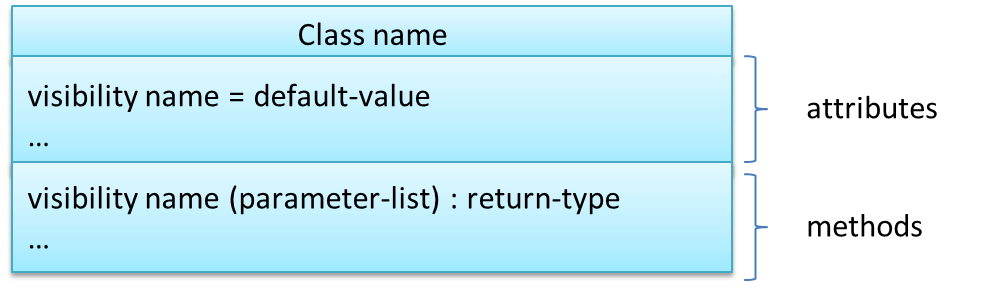
A Table class shown in UML notation:
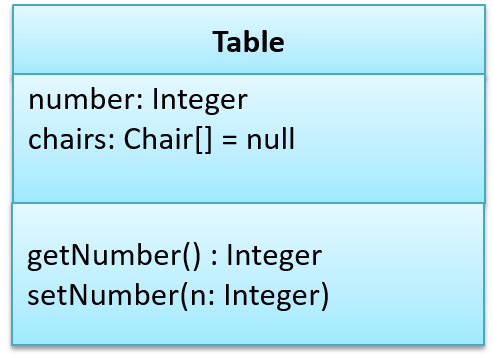
The equivalent code
class Table{ Integer number; Chair[] chairs = null; Integer getNumber(){ //... } void setNumber(Integer n){ //... }}class Table: def __init__(self): self.number = 0 self.chairs = [] def get_number(self): # ... def set_number(self, n): # ...The 'Operations' compartment and/or the 'Attributes' compartment may be omitted if such details are not important for the task at hand. 'Attributes' always appear above the 'Operations' compartment. All operations should be in one compartment rather than each operation in a separate compartment. Same goes for attributes.

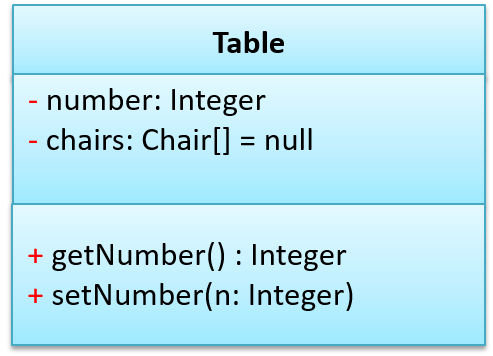
The visibility of attributes and operations is used to indicate the level of access allowed for each attribute or operation. The types of visibility and their exact meanings depend on the programming language used. Here are some common visibilities and how they are indicated in a class diagram:
+: public-: private#: protected~: package private
How visibilities map to programming language features
| visibility | Java | Python |
|---|---|---|
- private |
private |
at least two leading underscores (and at most one trailing underscores) in the name |
# protected |
protected |
one leading underscore in the name |
+ public |
public |
all other cases |
~ package private |
default visibility | not applicable |
Table class with visibilities shown:
Exercises
Which classes are correct?
Which of these follow the correct UML notation?
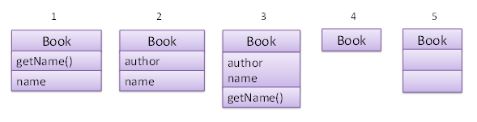
- 1
- 2
- 3
- 4
- 5
- Incorrect : Attributes compartment should be above the Methods compartment.
- Incorrect : All attributes should be inside the same compartment.
- Correct
- Correct : Both Attributes and Methods compartments can be omitted.
- Correct : The Attributes and Methods compartments can be empty.
Draw Car class
Draw a UML diagram to represent the Car class as given below. Include visibilities.
class Car{ Engine engine; private List<Wheel> wheels = null; public String model; public void drive(int speed){ move(speed); } private void move(int speed){ ... }} You may omit self from method signatures in the class diagram.
class Car: def __init__(self, model): self._engine = None # type: Engine self.__wheels = [] # type: a list of Wheel objects self.model = model # type: string def drive(self, speed): # speed is an int self.move(speed) def __move(self, speed): passCan interpret simple associations in a class diagram
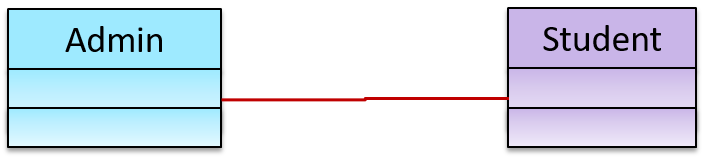
We use a solid line to show an association between two classes.

This example shows an association between the Admin class and the Student class:
Can interpret association navigabilities in class diagrams
We use arrow heads to indication the navigability of an association.
Logic is aware of Minefield, but Minefield is not aware of Logic

class Logic{ Minefield minefield;}class Minefield{ ...}class Logic: def __init__(self, minefield): self.minefield = minefield # ...class Minefield: # ...Here is an example of a bidirectional navigability; each class is aware of the other.

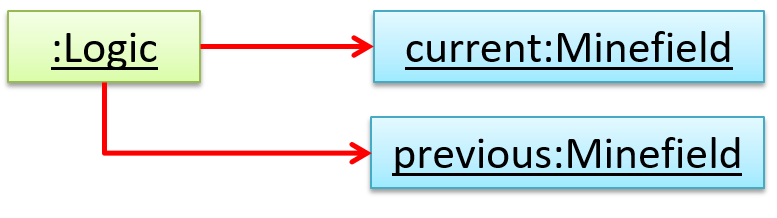
Navigability can be shown in class diagrams as well as object diagrams.
According to this object diagram the given Logic object is associated with and aware of two MineField objects.
Exercises
What does the navigability given by this diagram mean?
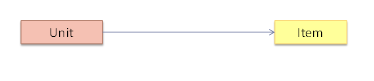
(a)
Explanation: The diagram indicates that Unit object should know about the Item object. In the implementation, the Unit object will hold a Unit object in one of its variables.
Can explain/use association roles in class diagrams
Association Role labels are used to indicate the role played by the classes in the association.

This association represents a marriage between a Man object and a Woman object. The respective roles played by objects of these two classes are husband and wife.
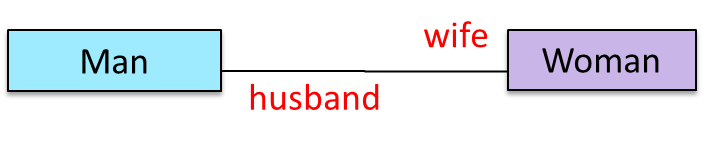
Note how the variable names match closely with the association roles.
class Man{ Woman wife;}class Woman{ Man husband;}class Man: def __init__(self): self.wife = None # a Woman objectclass Woman: def __init__(self): self.husband = None # a Man object The role of Student objects in this association is charges (i.e. Admin is in charge of students)
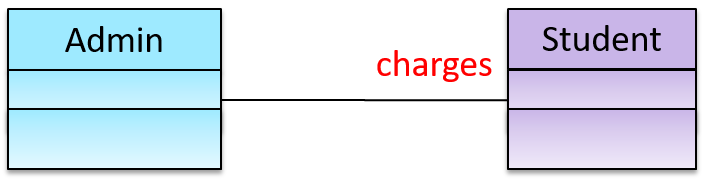
class Admin{ List<Student> charges;}class Admin: def __init__(self): self.charges = [] # list of Student objectsCan explain/use association labels in class diagrams
Association labels describe the meaning of the association. The arrow head indicates the direction in which the label is to be read.

In this example, the same association is described using two different labels.

- Diagram on the left:
Adminclass is associated withStudentclass because anAdminobject uses aStudentobject. - Diagram on the right:
Adminclass is associated withStudentclass because aStudentobject is used by anAdminobject.
Can explain what is the multiplicity of an association
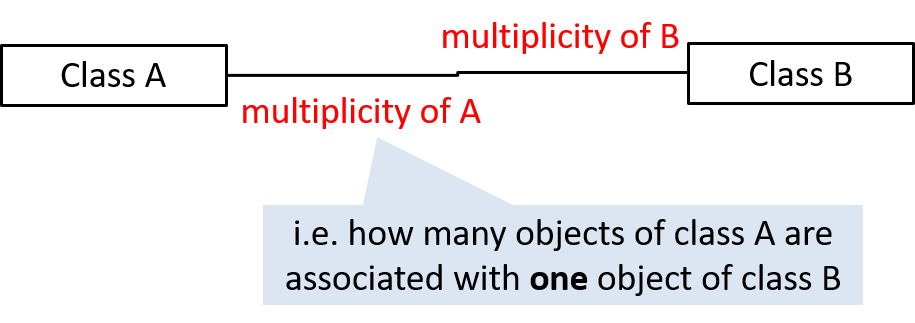
Commonly used multiplicities:
0..1: optional, can be linked to 0 or 1 objects1: compulsory, must be linked to one object at all times.*: can be linked to 0 or more objects.n..m: the number of linked objects must bentominclusive
In the diagram below, an Admin object administers (in charge of) any number of students but a Student object must always be under the charge of exactly
one
Admin object

In the diagram below,
- Each student must be supervised by exactly one professor. i.e. There cannot be a student who doesn't have a supervisor or has multiple supervisors.
- A professor cannot supervise more than 5 students but can have no students to supervise.
- An admin can handle any number of professors and any number of students, including none.
- A professor/student can be handled by any number of admins, including none.

Exercises
Which statement agrees with the multiplicity shown in this diagram?
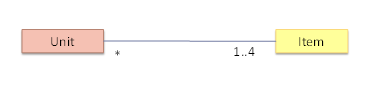
- a. A
Unitobject can be linked to any number ofItemobjects - b. An
Itemobject must be linked 1,2,3 or 4Unitobjects. - c. A
Unitobject must be linked 1,2,3, or 4Itemobjects - d. A
Itemobject can be 0 or moreUnitobjects.
(c)(d)

Can show an association as an attribute
An association can be shown as an attribute instead of a line.
Association multiplicities and the default value too can be shown as part of the attribute using the following notation. Both are optional.
name: type [multiplicity] = default value
The diagram below depicts a multi-player Square Game being played on a board comprising of 100 squares. Each of the squares may be occupied with any number of pieces, each belonging to a certain player.
A Piece may or may not be on a Square. Note how that association can be replaced by an isOn attribute of the Piece class. The isOn attribute can either be null or
hold a reference to a Square object, matching the 0..1 multiplicity of the association it replaces. The default value is null.
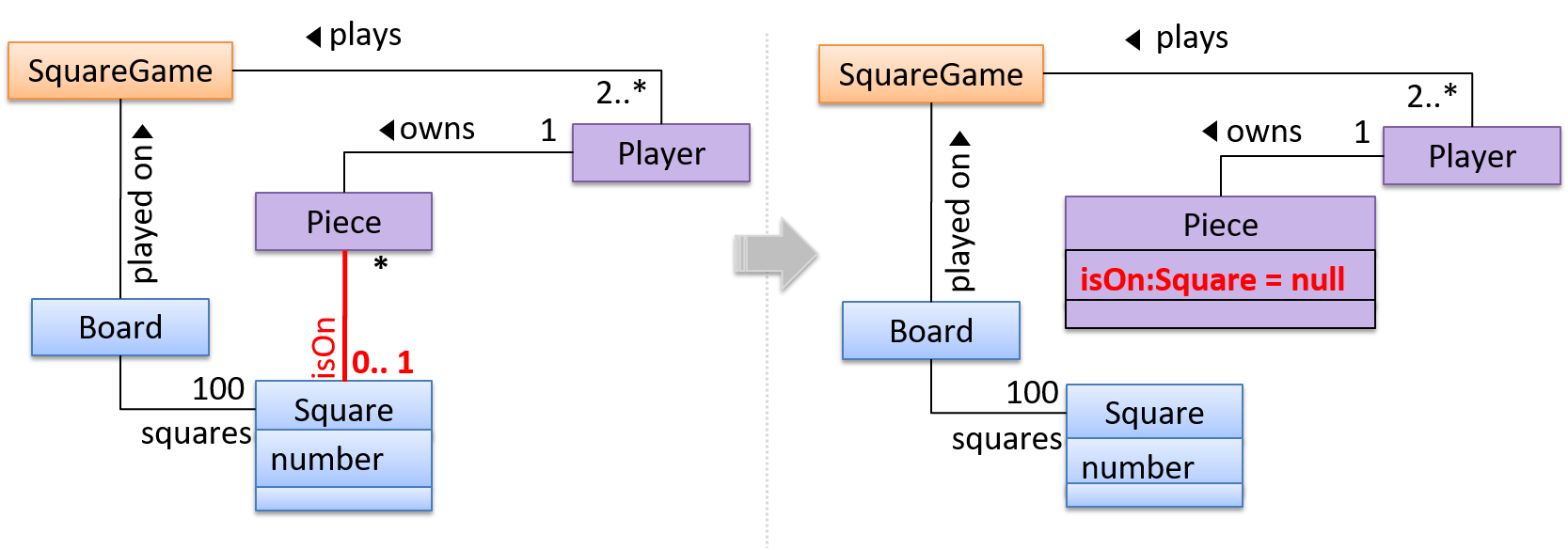
The association that a Board has 100 Squares can be shown in either of these two ways:

Show each association as either an attribute or a line but not both. A line is preferred is it is easier to spot.
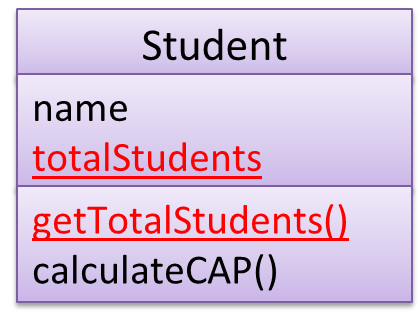
Can interpret association classes in class diagrams
Association classes are denoted as a connection to an association link using a dashed line as shown below.
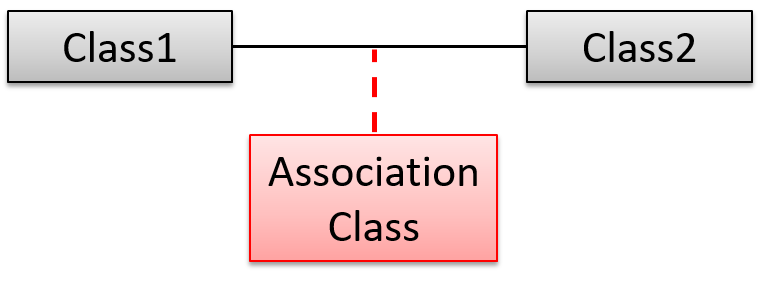
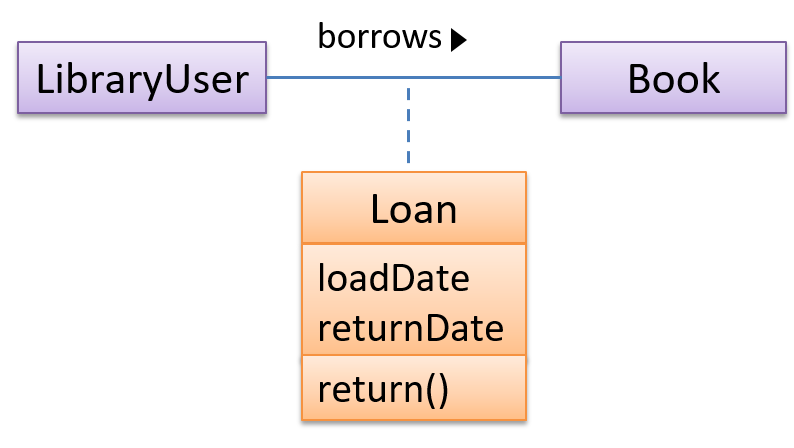
In this example Loan is an association class because it stores information about the borrows association between the User and the Book.

Can interpret aggregation in class diagrams
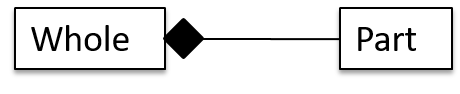
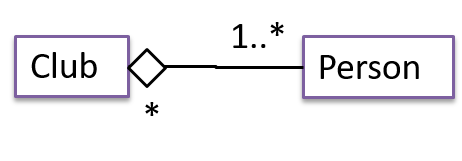
UML uses a hollow diamond is used to indicate an aggregation.
Notation:

Example:
Aggregation vs Composition
The distinction between composition (◆) and aggregation (◇) is rather blurred. Martin Fowler’s famous book UML Distilled advocates omitting the aggregation symbol altogether because using it adds more confusion than clarity.
Exercises
Which one is not recommended to use?
Which one of these is recommended not to use in UML diagrams because it adds more confusion than clarity?
(b)
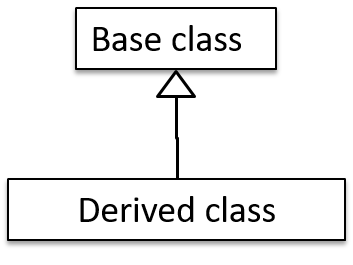
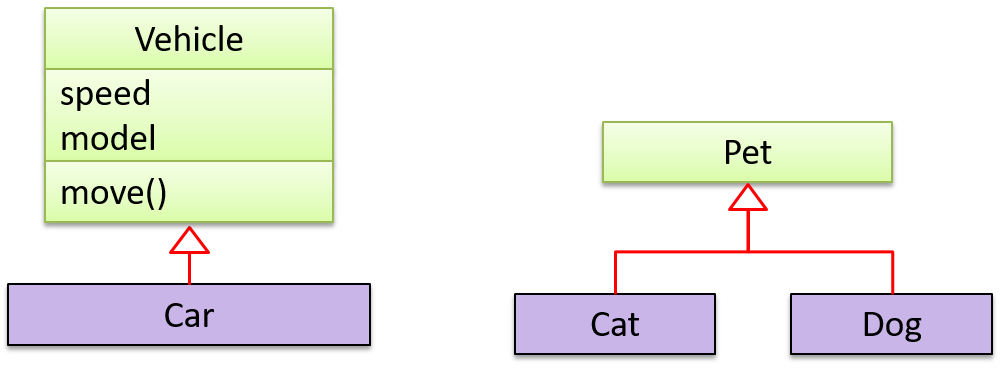
Can interpret interfaces in class diagrams
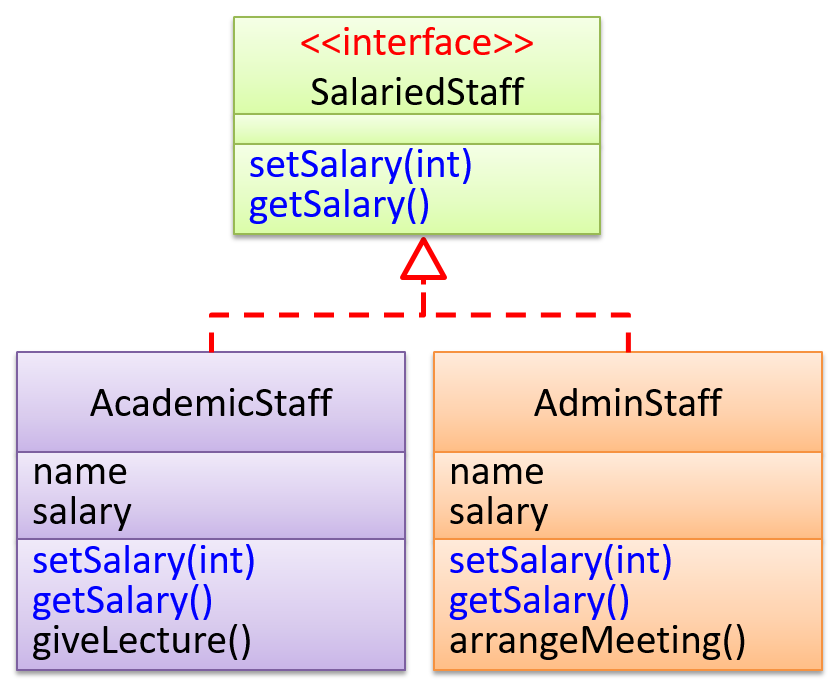
An interface is shown similar to a class with an additional keyword <<interface>>. When a class implements an interface, it is shown similar to class inheritance except a dashed line is used instead of a solid line.
The AcademicStaff and the AdminStaff classes implement the SalariedStaff interface.
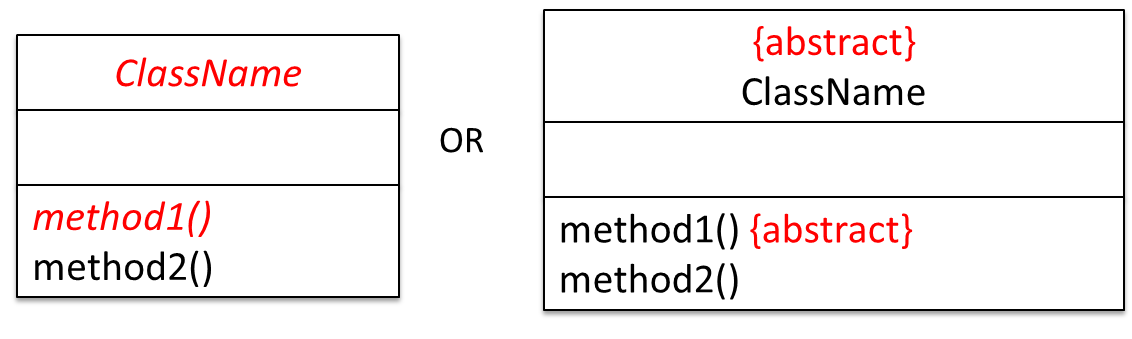
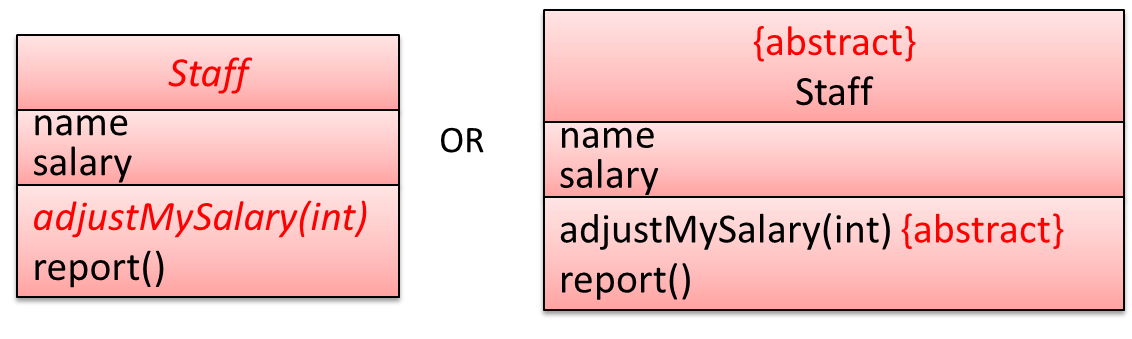
Can combine different basic aspects of class diagrams
Exercises
Class Diagram for code
Draw a class diagram for the code below. Also draw an object diagram that will represent the object structure after running Main#main().
- Make the multiplicities as strict as possible without contradicting the code.
- You may omit the
Mainclass from both diagrams.
import java.util.ArrayList;import java.util.List;public class Main { public static void main(String[] args) { Item item1 = new Item(); Item item2 = new Item(); Box box1 = new Box(item1); Box box2 = new Box(item2); item2.setMainCard(new Card()); item2.addPreviousBox(box1); item2.addPreviousBox(box2); }}class Box{ private Item item; Box (Item item){ this.item = item; }}class Item{ private List<Box> previousBoxes = new ArrayList<>(); private Card mainCard = null; private Card subCard = null; void setMainCard(Card card){ this.mainCard = card; } void setSubCard(Card card){ this.subCard = card; } void addPreviousBox(Box previousBox){ previousBoxes.add(previousBox); }}class Card{}Draw a class diagram for the code below. Also draw an object diagram that will represent the object structure after running the code. Make the multiplicities as strict as possible without contradicting the code.
class Box: def __init__(self, item): self.__item = item # type: Itemclass Item: def __init__(self): self.__previous_boxes = [] # type: list of Box objects self.__main_card = None # type: Car self.__sub_card = None # type: Card def set_main_card(self, card): self.__main_card = card # type: Card def set_sub_card(self, card): self.__sub_card = card # type: Card def add_previous_box(self, previous_box): self.__previous_boxes.append(previous_box)class Card: passitem1 = Item();item2 = Item();box1 = Box(item1);box2 = Box(item2);item2.set_main_card(Card());item2.add_previous_box(box1);item2.add_previous_box(box2);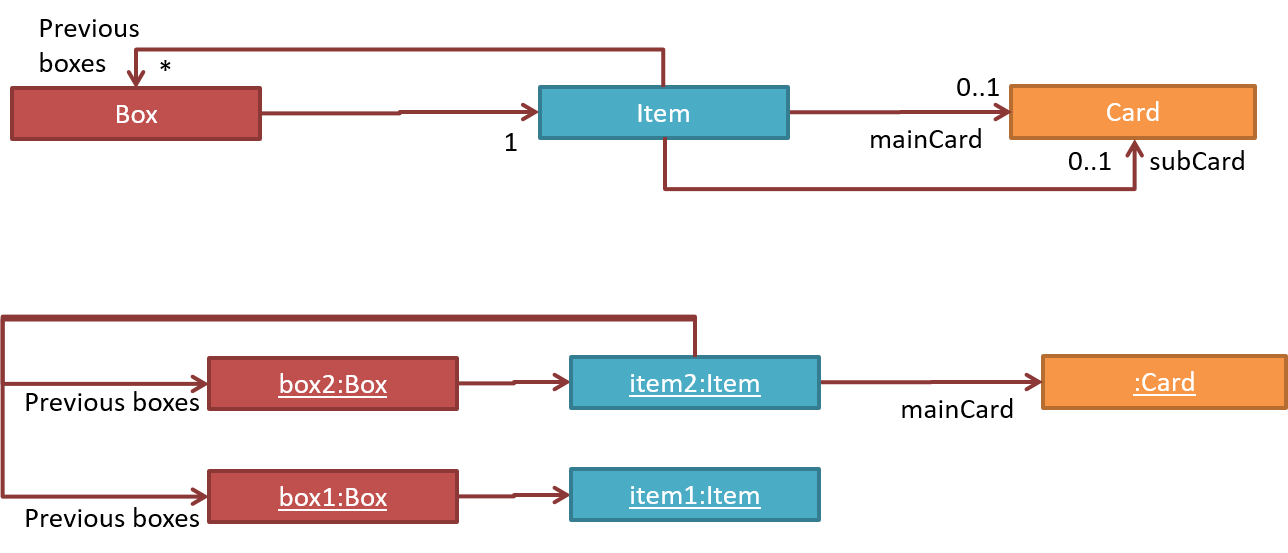
Implement Class Diagram
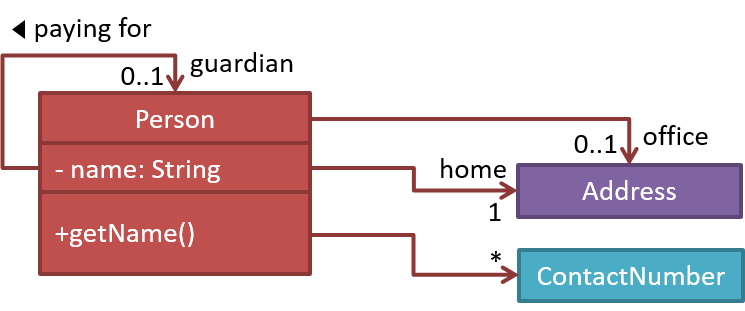
Implement the class structure given below:
Draw an Object Diagrams for the Class Diagram (Person-Guardian)
Suppose we wrote a program to follow the class structure given in this class diagram:
Draw object diagrams to represent the object structures after each of these steps below. Assume that we are trying to minimize the number of total objects.
i.e. apply step 1 → [diagram 1] → apply step 2 on diagram 1 → [diagram 2] and so on.
-
There are no persons.
-
Alfredis the Guardian ofBruce. -
Bruce's contact number is the same asAlfred's. -
Alfredis also the guardian of another person. That person listsAlfreds home address as his home address as well as office address. -
Alfredhas a an office address atWayne Industriesbuilding which is different from his home address (i.e.Bat Cave).
After step 2, the diagram should be like this:

Can explain/identify sequence diagrams
A UML sequence diagram captures the interactions between multiple objects for a given scenario.
Consider the code below.
class Machine { Unit producePrototype() { Unit prototype = new Unit(); for (int i = 0; i < 5; i++) { prototype.stressTest(); } return prototype; }}class Unit { public void stressTest() { }}Here is the sequence diagram to model the interactions for the method call producePrototype() on a Machine object.
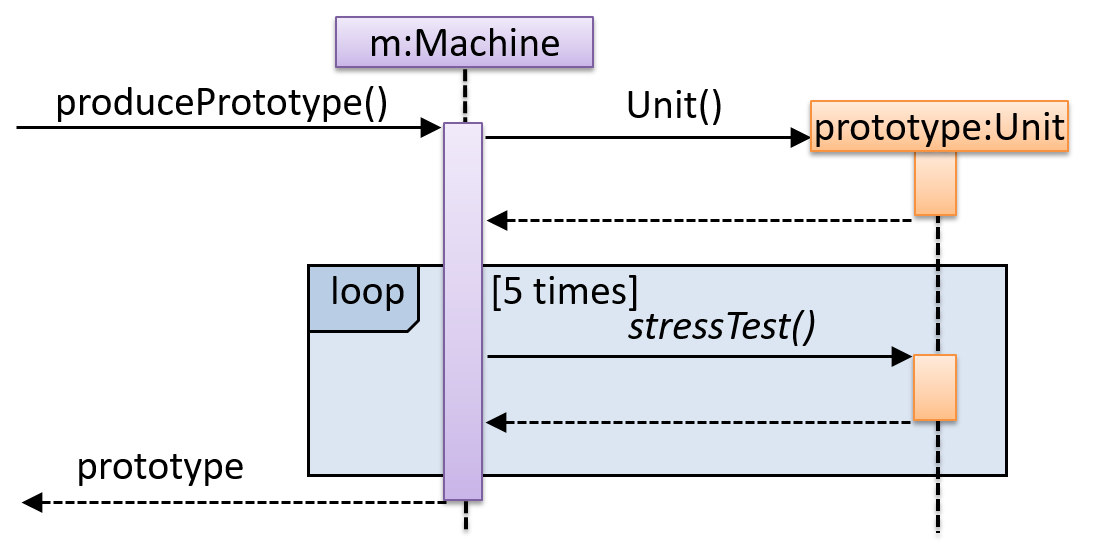
Can interpret sequence diagrams with basic notation
Notation:
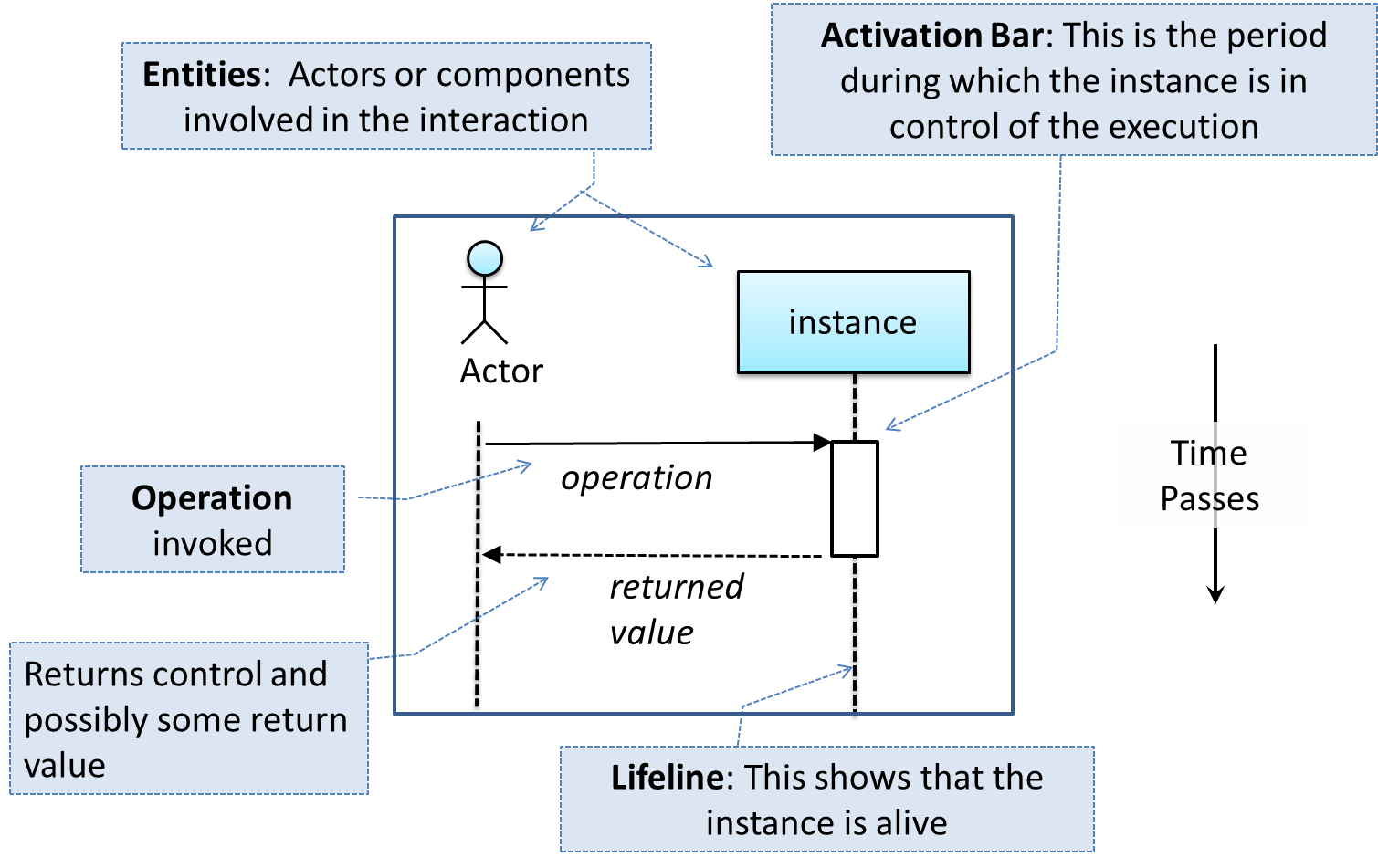
This sequence diagram shows some interactions between a human user and the Text UI of a
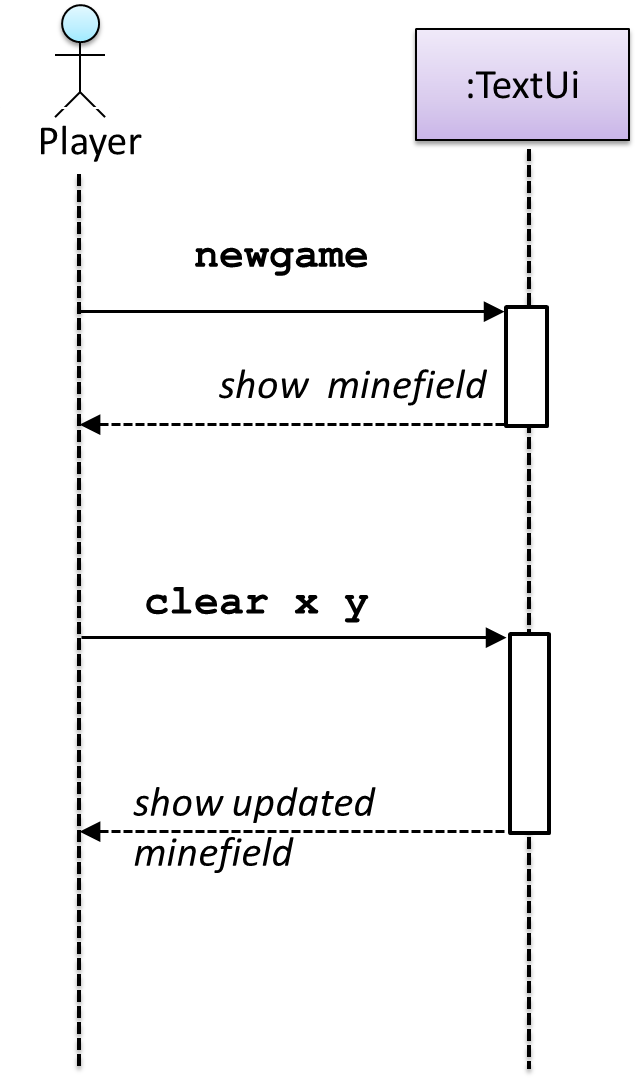
The player runs the newgame action on the TextUi object which results in the TextUi showing the minefield to the player. Then, the player runs the clear x y command; in response, the TextUi object shows the updated minefield.
The :TextUi in the above example denotes an unnamed instance of the class TextUi. If there were two instances of TextUi in the diagram, they can be distinguished by naming them e.g. TextUi1:TextUi and
TextUi2:TextUi.
Arrows representing method calls should be solid arrows while those representing method returns should be dashed arrows.
Note that unlike in object diagrams, the class/object name is not underlined in sequence diagrams.
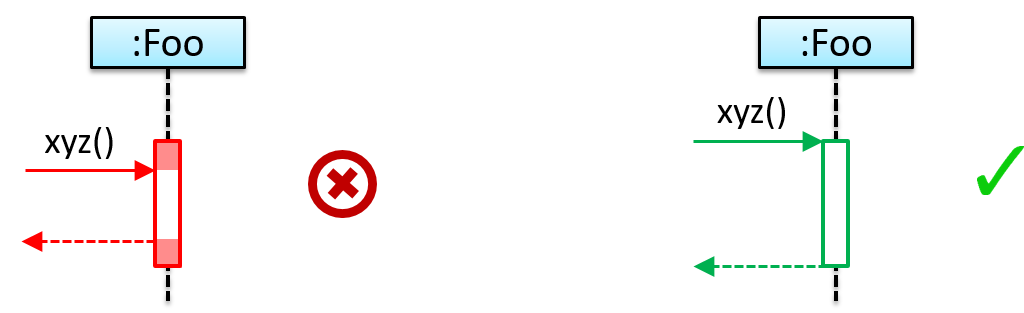
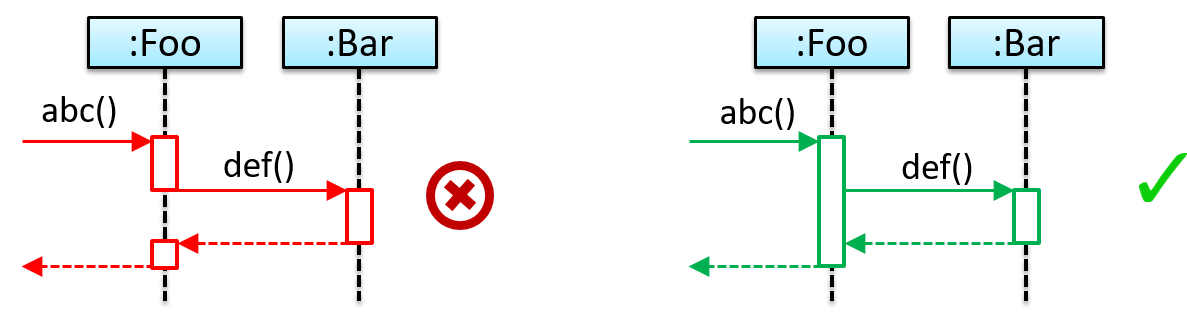
[Common notation error] Activation bar too long: The activation bar of a method cannot start before the method call arrives and a method cannot remain active after the method had returned. In the two sequence diagrams below, the one on the left commits this error because the activation bar starts before the method Foo#xyz() is called and remains active after the method returns.
[Common notation error] Broken activation bar: The activation bar should remain unbroken from the point the method is called until the method returns. In the two sequence diagrams below, the one on the left commits this error because the activation bar for the method Foo#abc() is not contiguous, but appears as two pieces instead.
Can interpret sequence diagrams with object creation
Notation:
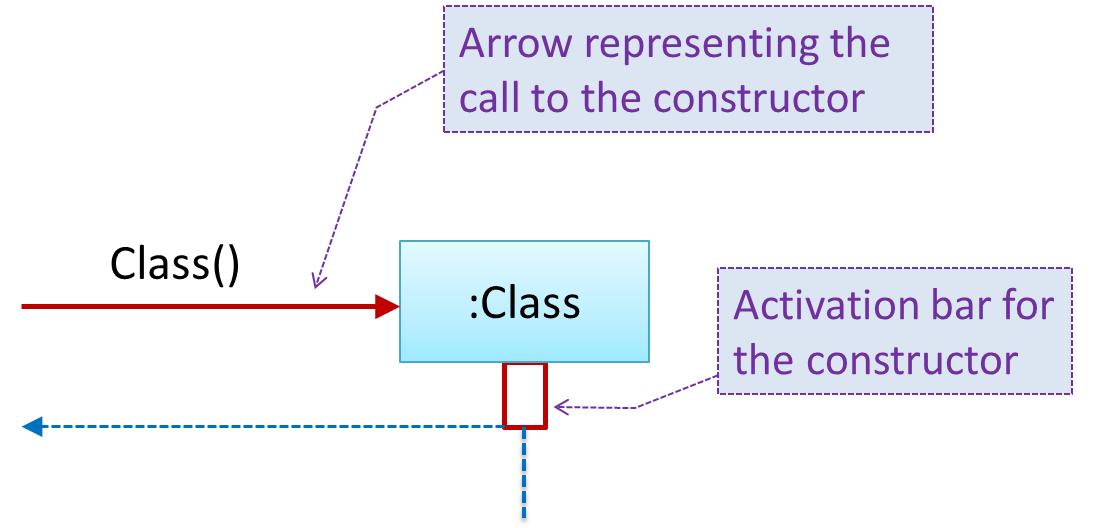
- The arrow that represents the constructor arrives at the side of the box representing the instance.
- The activation bar represents the period the constructor is active.
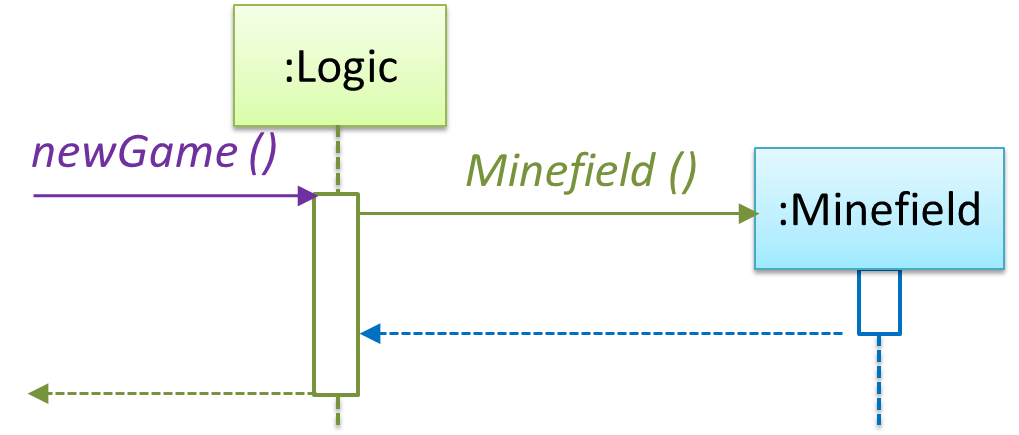
The Logic object creates a Minefield object.
Can interpret sequence diagrams with object deletion
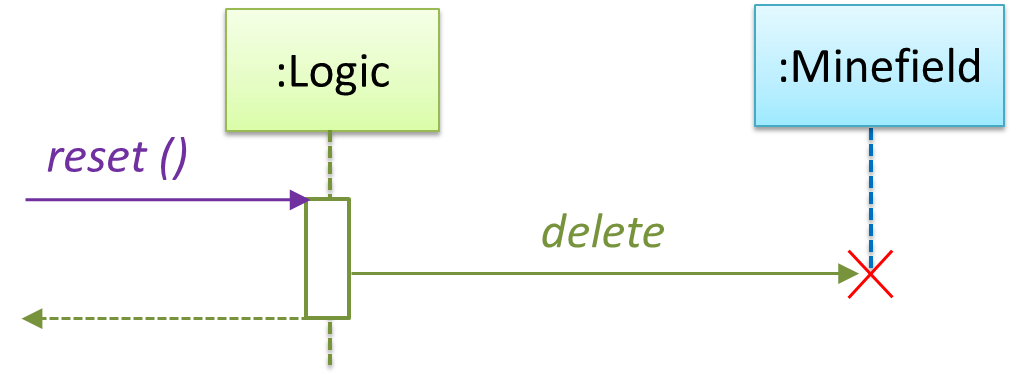
UML uses an X at the end of the lifeline of an object to show it's deletion.
Although object deletion is not that important in languages such as Java that support automatic memory management, you can still show object deletion in UML diagrams to indicate the point at which the object ceases to be used.
Notation:
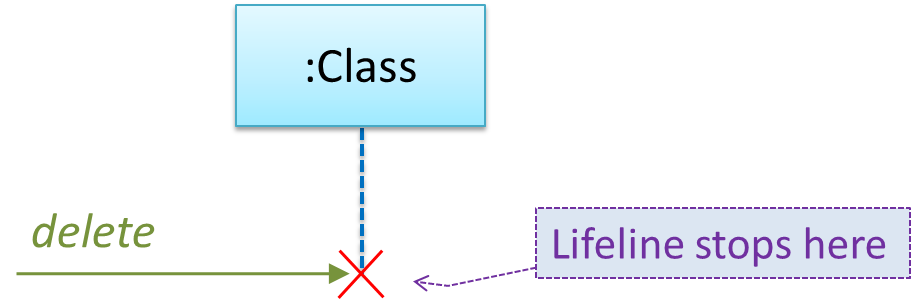
Note how the diagrams shows the deletion of the Minefield object
Can interpret sequence diagrams with loops
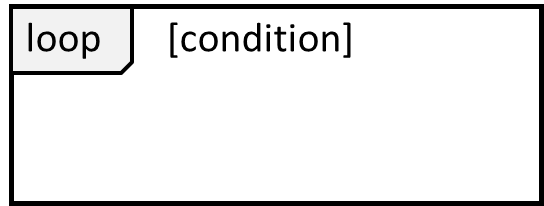
Notation:
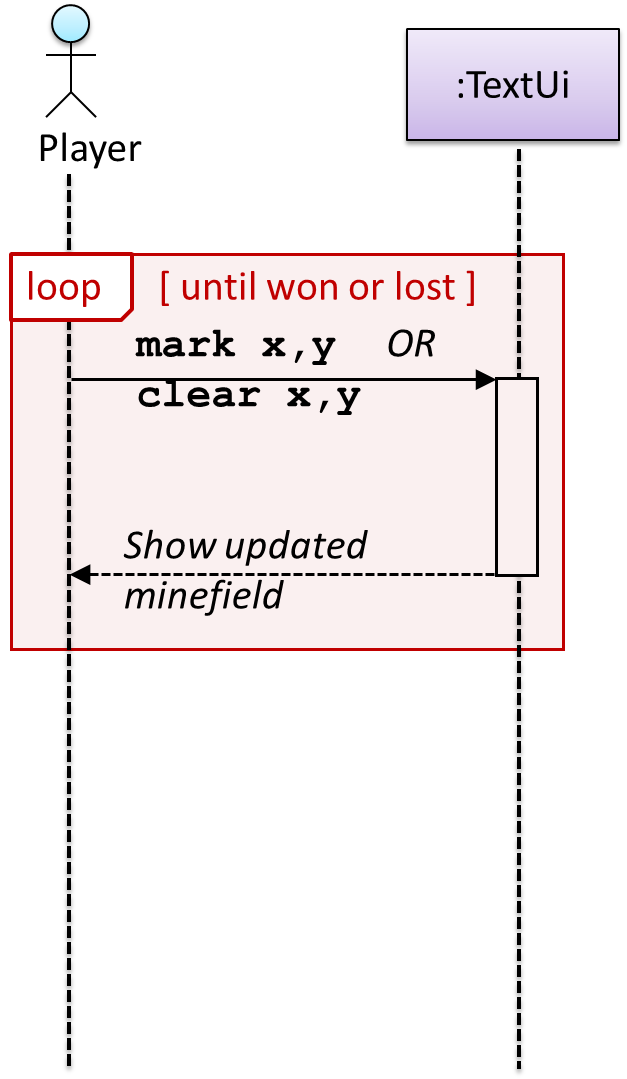
The Player calls the mark x,y command or clear x y command repeatedly until the game is won or lost.
Can interpret sequence diagrams with self invocation
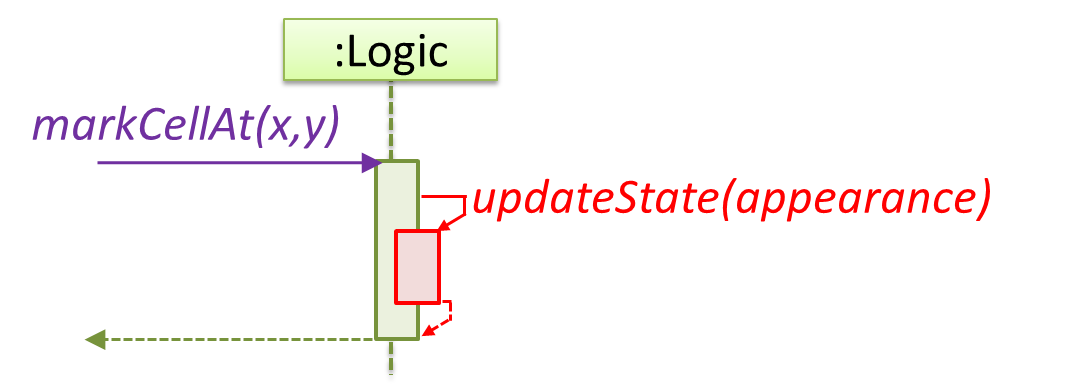
UML can show a method of an object calling another of its own methods.
Notation:
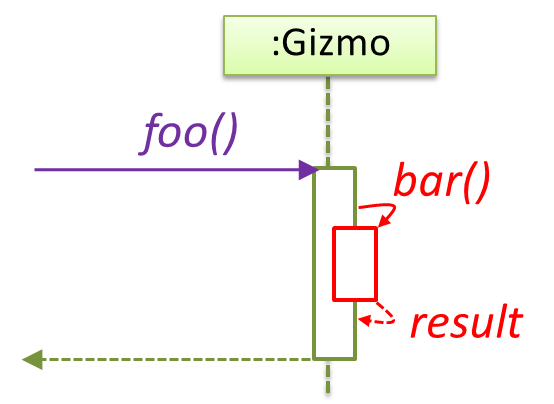
The markCellAt(...) method of a Logic object is calling its own updateState(...) method.
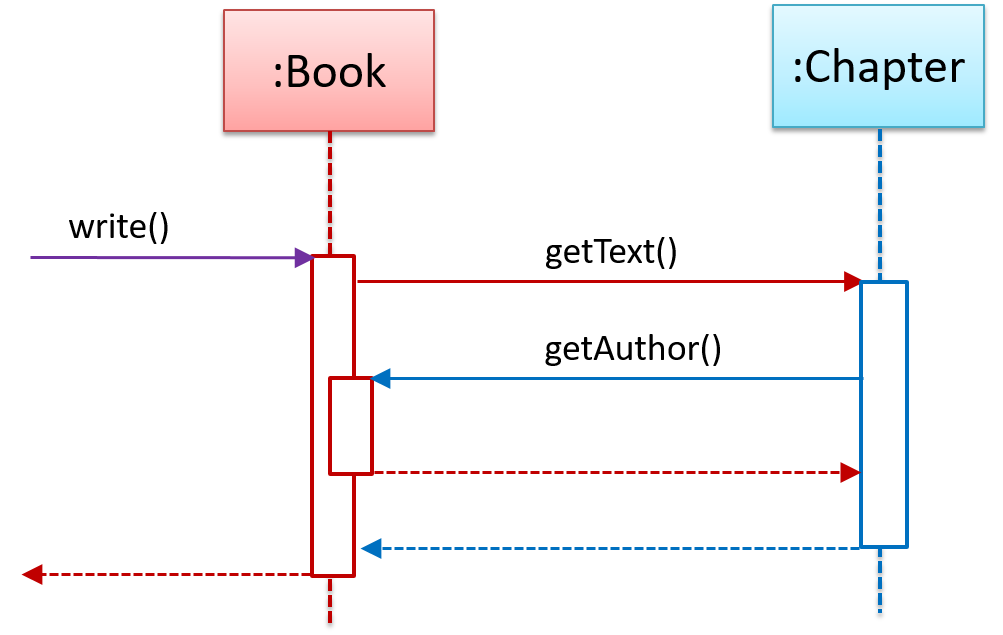
In this variation, the Book#write() method is calling the Chapter#getText() method which in turn does a call back by calling the getAuthor() method of the calling object.
Can interpret sequence diagrams with alternative paths
UML uses alt frames to indicate alternative paths.
Notation:
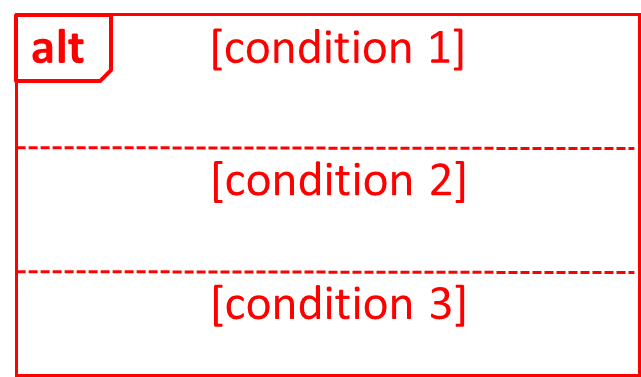
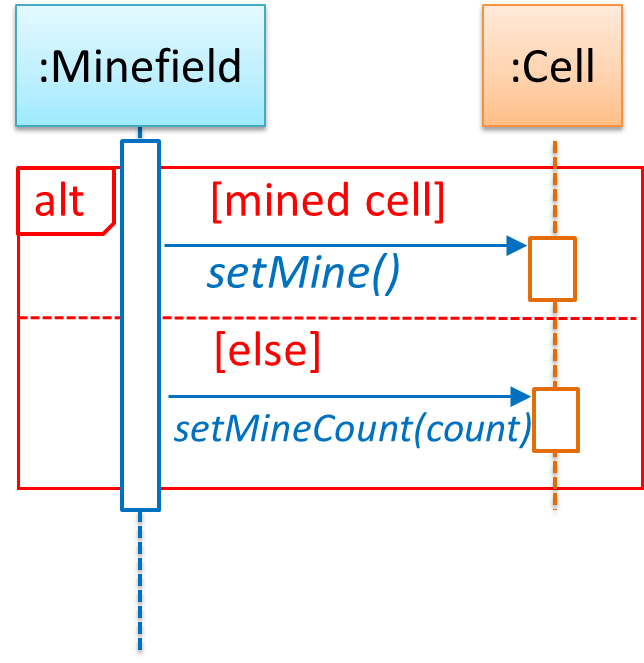
Minefield calls the Cell#setMine if the cell is supposed to be a mined cell, and calls the Cell:setMineCount(...) method otherwise.
Can interpret sequence diagrams with optional paths
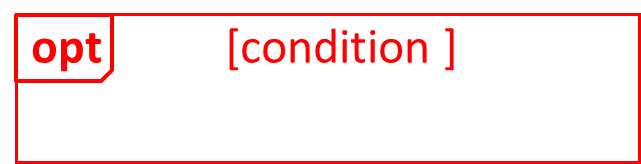
UML uses opt frames to indicate optional paths.
Notation:
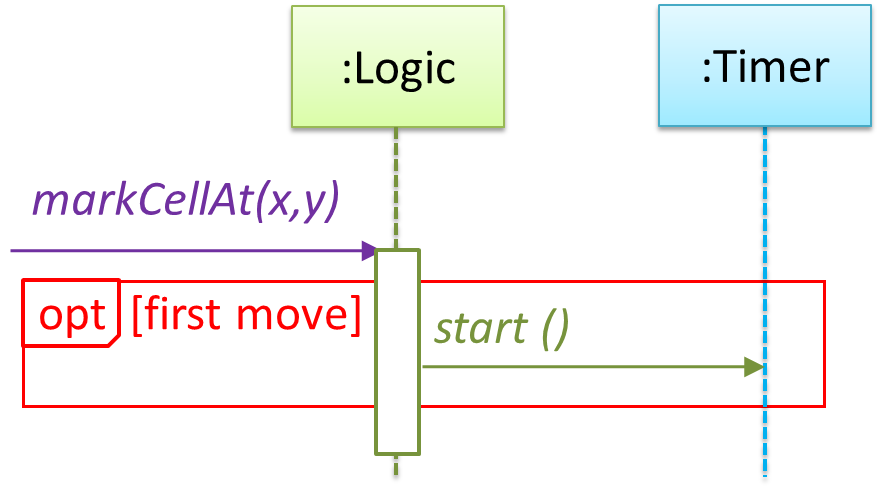
Logic#markCellAt(...) calls Timer#start() only if it is the first move of the player.
Can interpret sequence diagrams with parallel paths
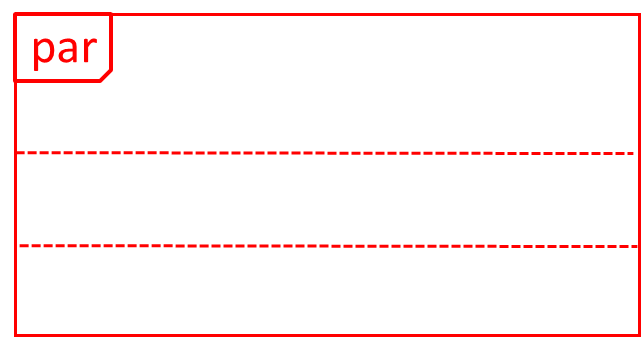
UML uses par frames to indicate parallel paths.
Notation:
Logic is calling methods CloudServer#poll() and LocalServer#poll() in parallel.
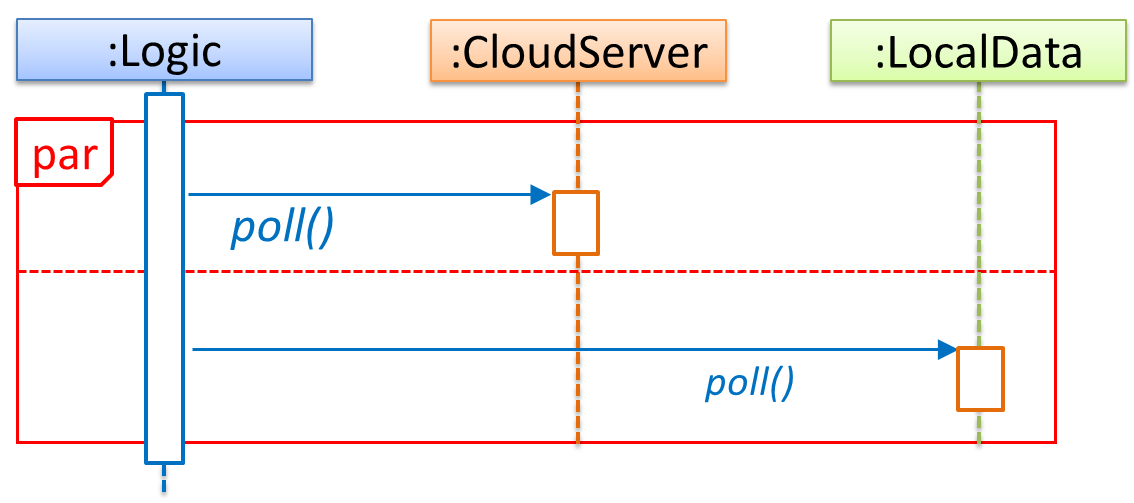
If you show parallel paths in a sequence diagram, the corresponding Java implementation is likely to be multi-threaded because a normal Java program cannot do multiple things at the same time.
Can interpret sequence diagrams with reference frames
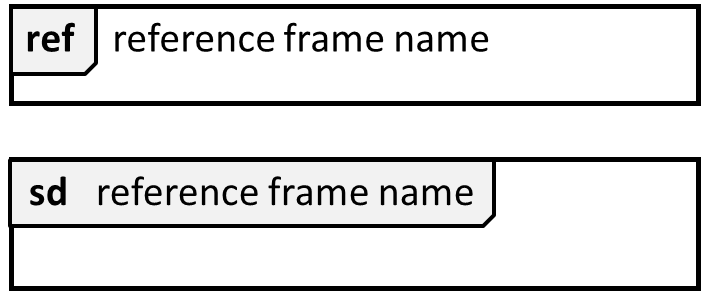
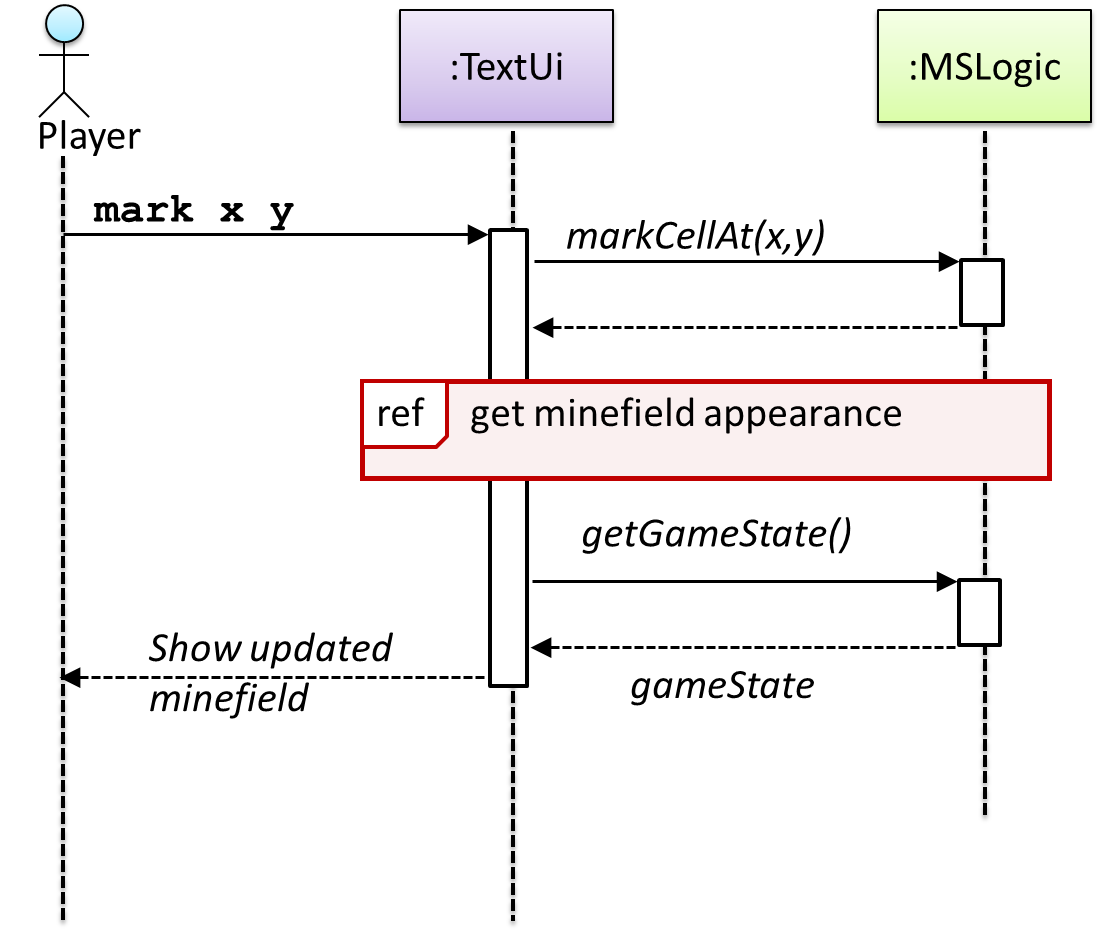
UML uses ref frame to allow a segment of the interaction to be omitted and shown as a separate sequence diagram. Reference frames help us to break complicated sequence diagrams into multiple parts or simply to omit details we are not interested in showing.
Notation:
The details of the get minefield appearance interactions have been omitted from the diagram.
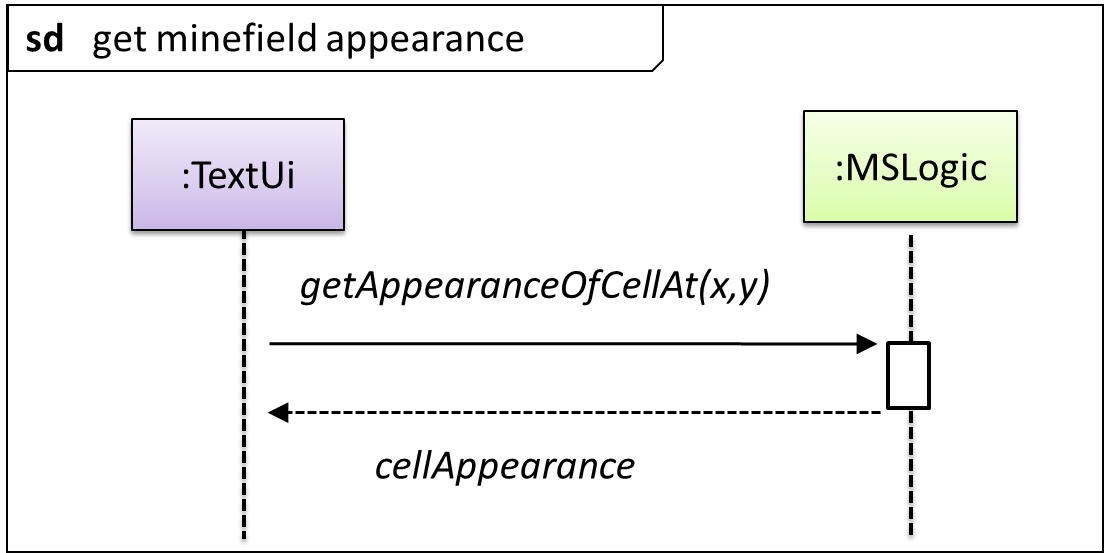
Those details are shown in a separate sequence diagram given below.
Can interpret sequence diagrams with minimal notation
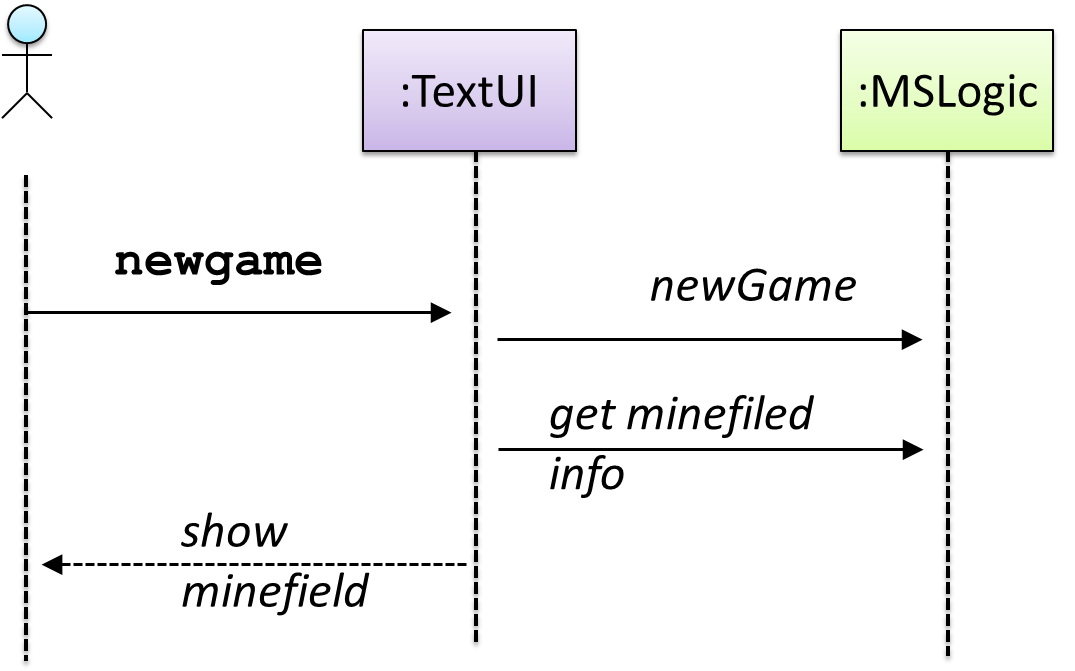
To reduce clutter, activation bars and return arrows may be omitted if they do not result in ambiguities or loss of information. Informal operation descriptions such as those given in the example below can be used, if more precise details are not required for the task at hand.
A minimal sequence diagram
Can show calls to static methods
Method calls to static i.e., class-level method are received by the class itself, not an instance of that class. We can use the <<class>> to show that a participant is the class itself.
In this example, m calls the static method Person.getMaxAge() and also the setAge() method of a Person object p.
Can explain/identify object diagrams
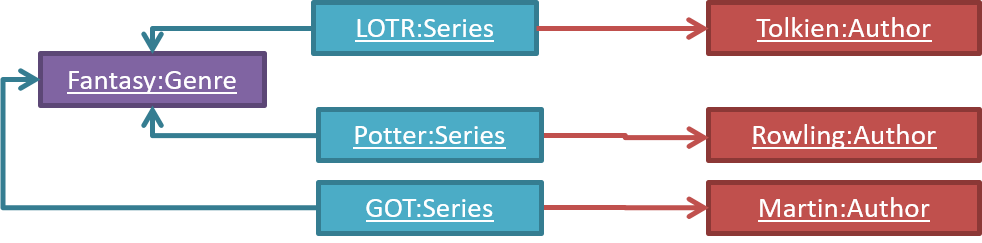
An object diagram shows an object structure at a given point of time.
An example object diagram:
Can draw UML objects
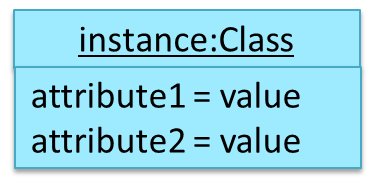
Notation:
Notes:
- The class name and object name e.g.
car1:Carare underlined. objectName:ClassNameis meant to say 'an instance ofClassNameidentified asobjectName'.- Unlike classes, there is no compartment for methods.
- Attributes compartment can be omitted if it is not relevant to the task at hand.
- Object name can be omitted too e.g.
:Carwhich is meant to say 'an unnamed instance of a Car object'.
Some example objects:

Exercises
Draw Car object
Draw a UML diagram to represent the Car object created by the following code.
class Car{ private double price; private int speed; Car(double price, int speed){ //... }}// somewhere else in the codeCar myCar = new Car(13.5, 200);class Car: def __init__(self, price, speed): self.__price = price # type: float self.__speed = speed # type: int# somewhere else in the codemy_car = Car(13.5, 200);
Can explain activity diagrams
Unified Modeling Language (UML) is a graphical notation to describe various aspects of a software system. UML is the brainchild of three software modeling specialists James Rumbaugh, Grady Booch and Ivar Jacobson (also known as the Three Amigos). Each of them has developed their own notation for modeling software systems before joining force to create a unified modeling language (hence, the term ‘Unified’ in UML). UML is currently the de facto modeling notation used in the software industry.
An example activity diagram:

[source:wikipeida]
Can interpret linear paths in activity diagrams
An activity diagram (AD) captures an activity of actions and control flows that makes up the activity.
- An action is a single step in an activity. It is shown as a rectangle with rounded corners.
- A control flow shows the flow of control from one action to the next. It is shown by drawing a line with an arrow-head to show the direction of the flow.
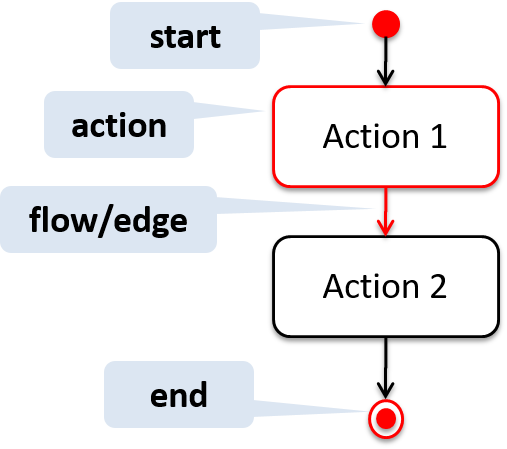
Note the slight difference between the start node and the end node which represent the start and the end of the activity, respectively.
This activity diagram shows the action sequence of the activity a passenger rides the bus:

Exercises
Which activity diagrams are correct?
Which of these activity diagrams use the correct UML notation?
- i
- ii
- iii
- iv
- v
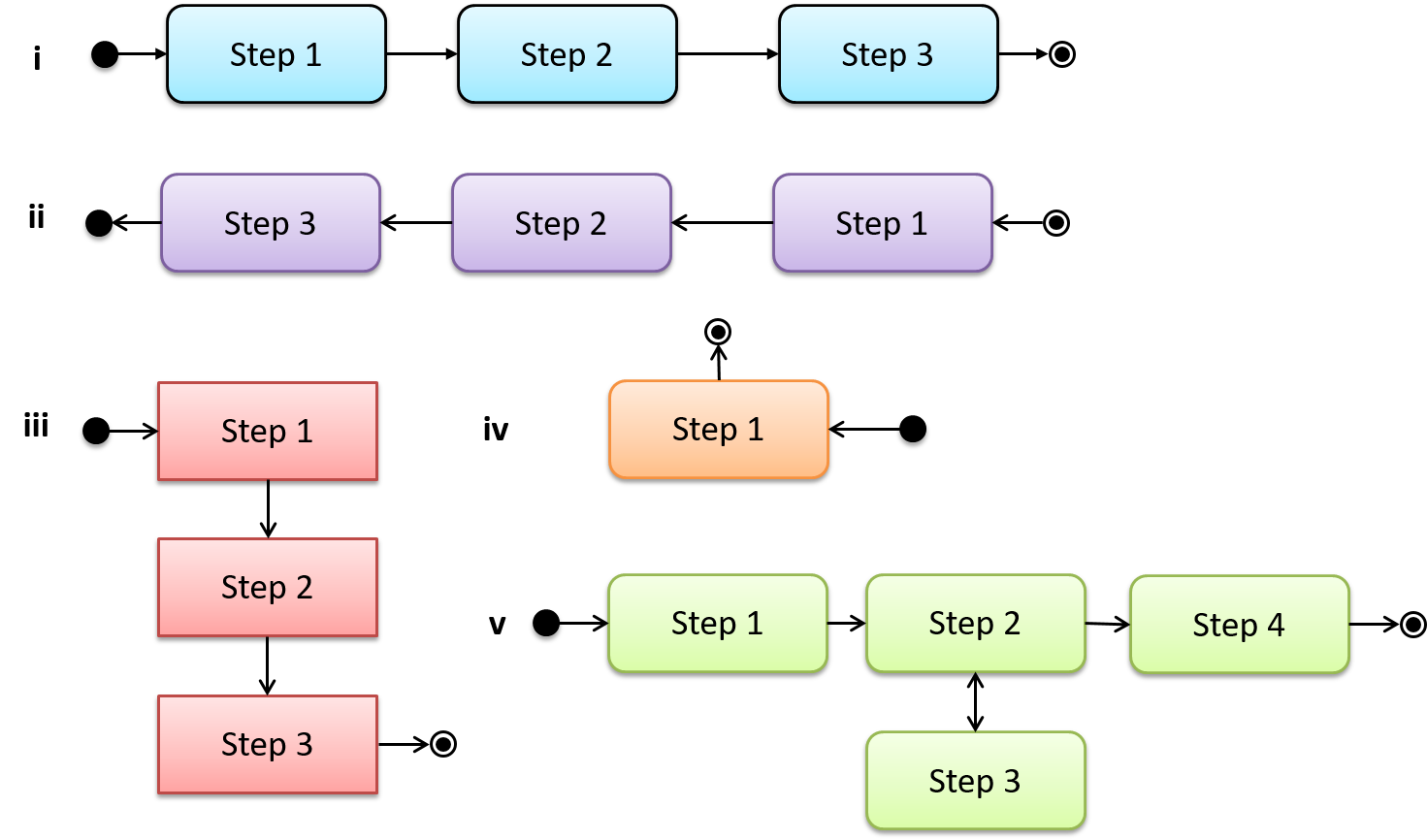
- i : 👍 Correct. The arrow-head type does not matter.
- ii : Incorrect. The start and end node notation is swapped.
- iii : Incorrect. Action boxes should have rounded corners.
- iv : 👍 Correct. An activity can have only one action.
- v : Incorrect. There cannot be any double-headed arrows.
Can interpret alternate paths in activity diagrams
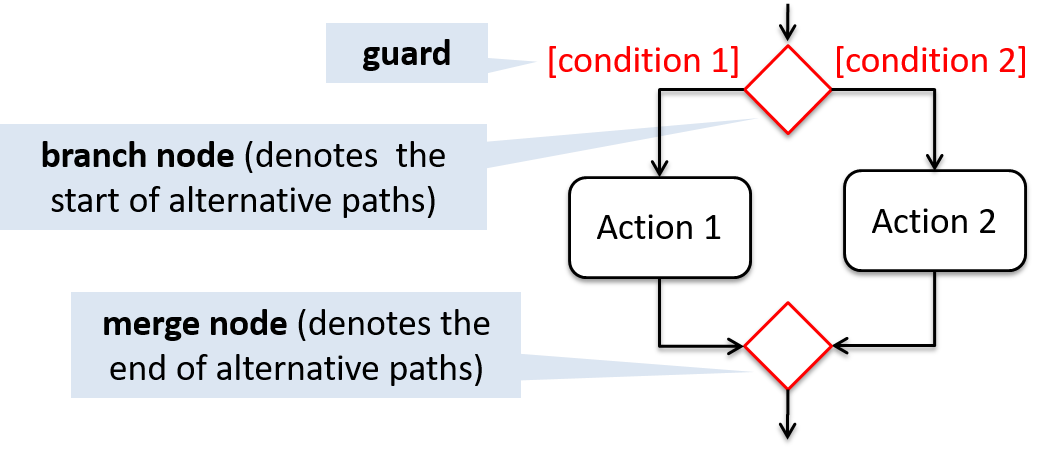
A branch node shows the start of alternate paths. Each control flow exiting a branch node has a guard condition : a boolean condition that should be true for execution to take that path. Only one of the guard condition can be true at any time.
A merge node shows the end of alternate paths.
Both branch nodes and merge nodes are diamond shapes. Guard conditions must be in square brackets.
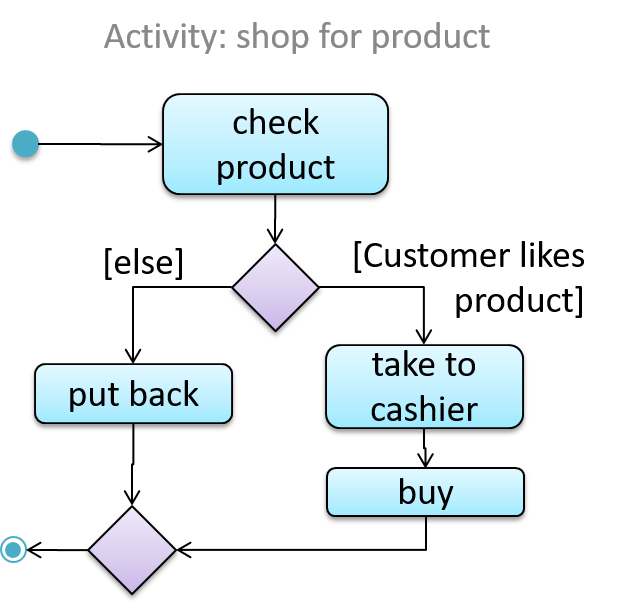
The AD below shows alternate paths involved in the workflow of the activity shop for product:
Exercises
Which activity diagrams are correct?
Which of these activity diagrams use the correct UML notation?
- i
- ii
- iii
- iv
- v
- vi
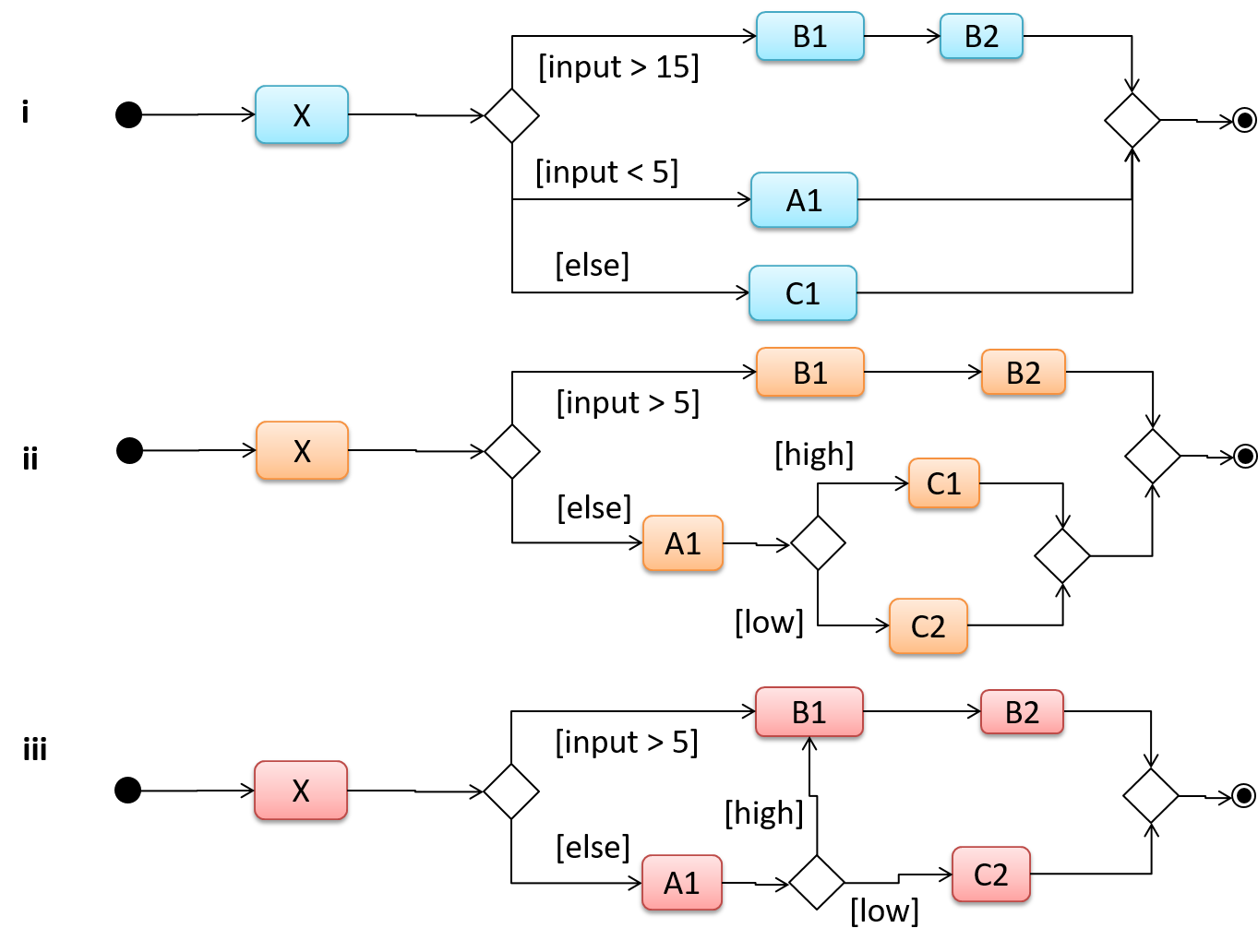
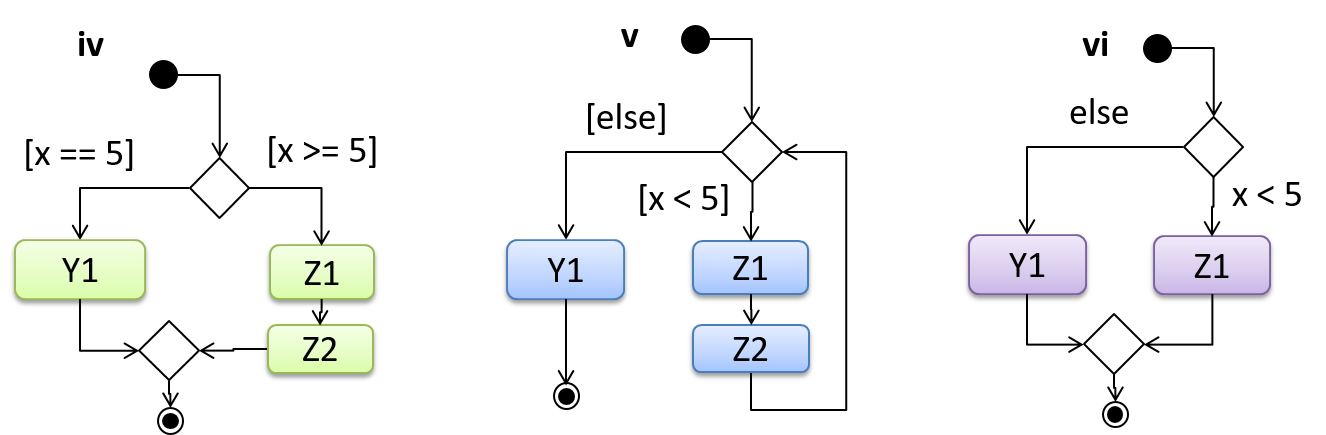
- i : 👍 Correct. There can be more than two alternate paths.
- ii : 👍 Correct. An alternate path can divide into more branches.
- iii : 👍 Correct. A branch can join other branches.
- iv : Incorrect. At
x=5both guard conditions become true. - v : 👍 Correct. It is fine for a branch to form a loop by going back to the original branch node.
- iv : Incorrect. Guard conditions should be given in square brackets.
Can interpret parallel paths in activity diagrams
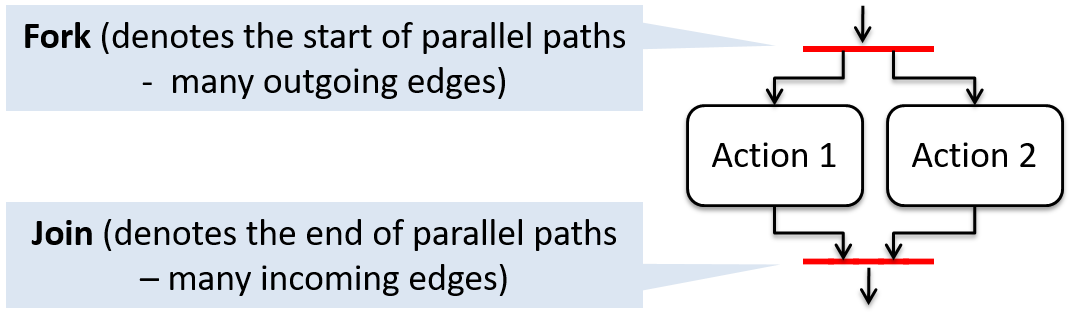
Fork nodes indicate the start of
Join nodes indicate the end of parallel paths.
Both have the same notation: a bar.
In a
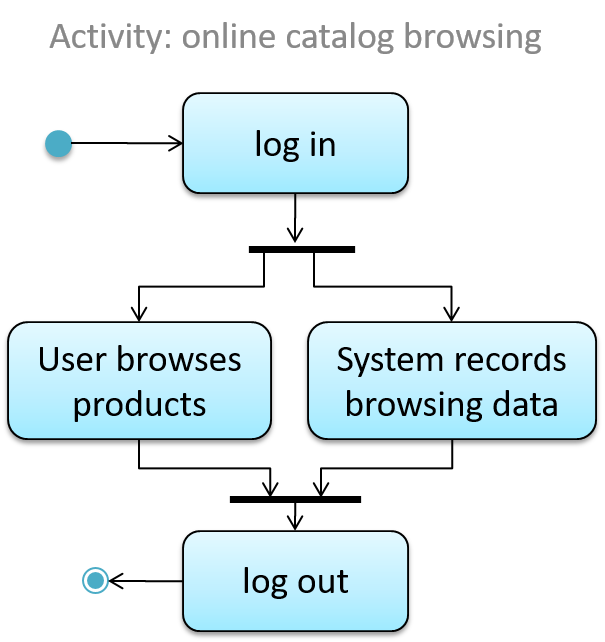
In this activity diagram (from an online shop website) the actions User browsers products and System records browsing data happen in parallel. Both of them need to finish before the log out action can take place.
Exercises
Which activity diagrams are correct?
Which of these activity diagrams use the correct UML notation?
- i
- ii
- iii
- iv
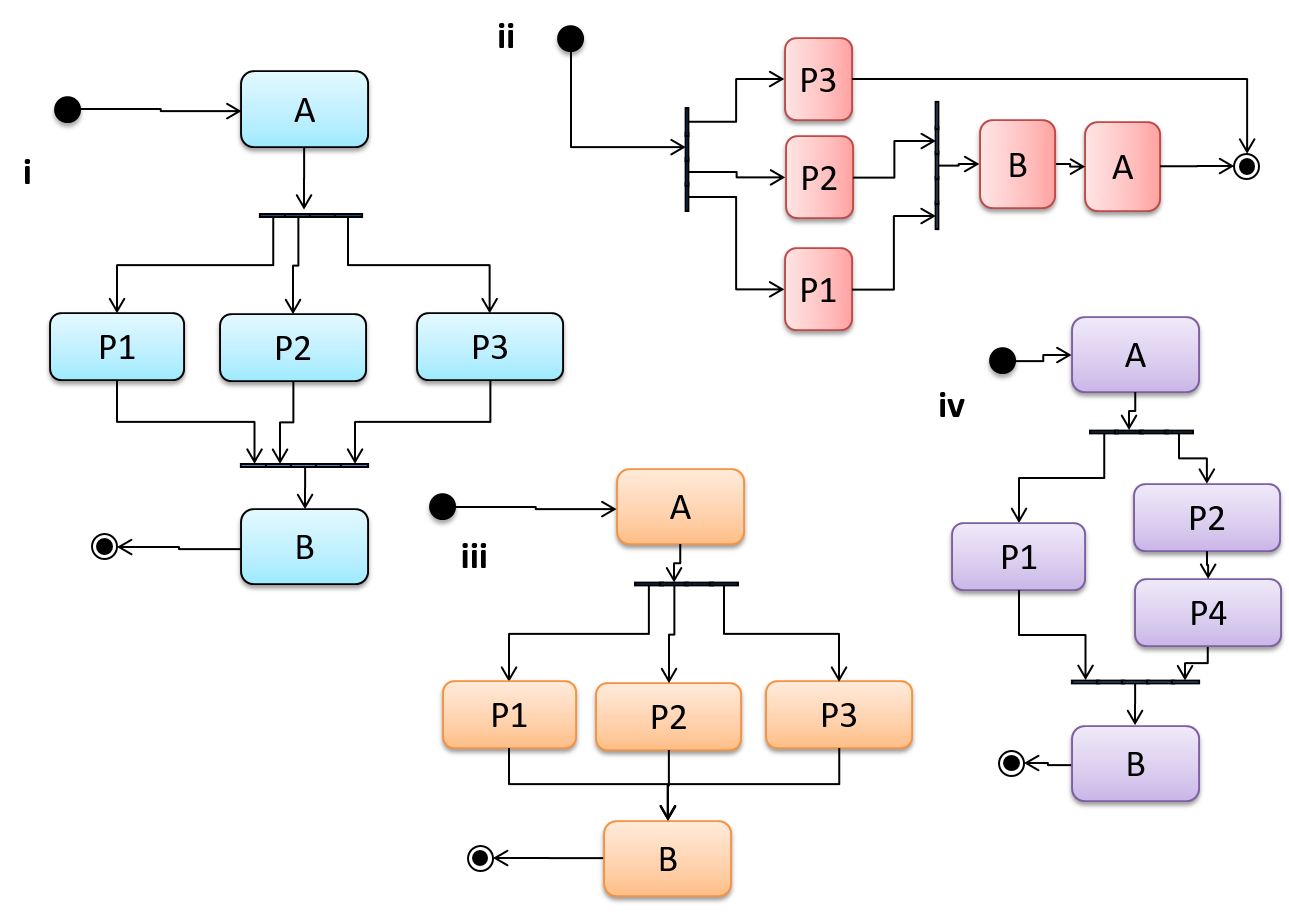
- i : 👍 Correct. There can be more than two parallel paths.
- ii : Incorrect. All parallel paths that started from a fork should end in the same join node.
- iii : Incorrect. Parallel paths must end with a join node.
- iv : 👍 Correct. A parallel path can have multiple actions.
Can use rakes in activity diagrams
The rake notation is used to indicate that a part of the activity is given as a separate diagram.
Here is the AD for a game of ‘Snakes and Ladders’.
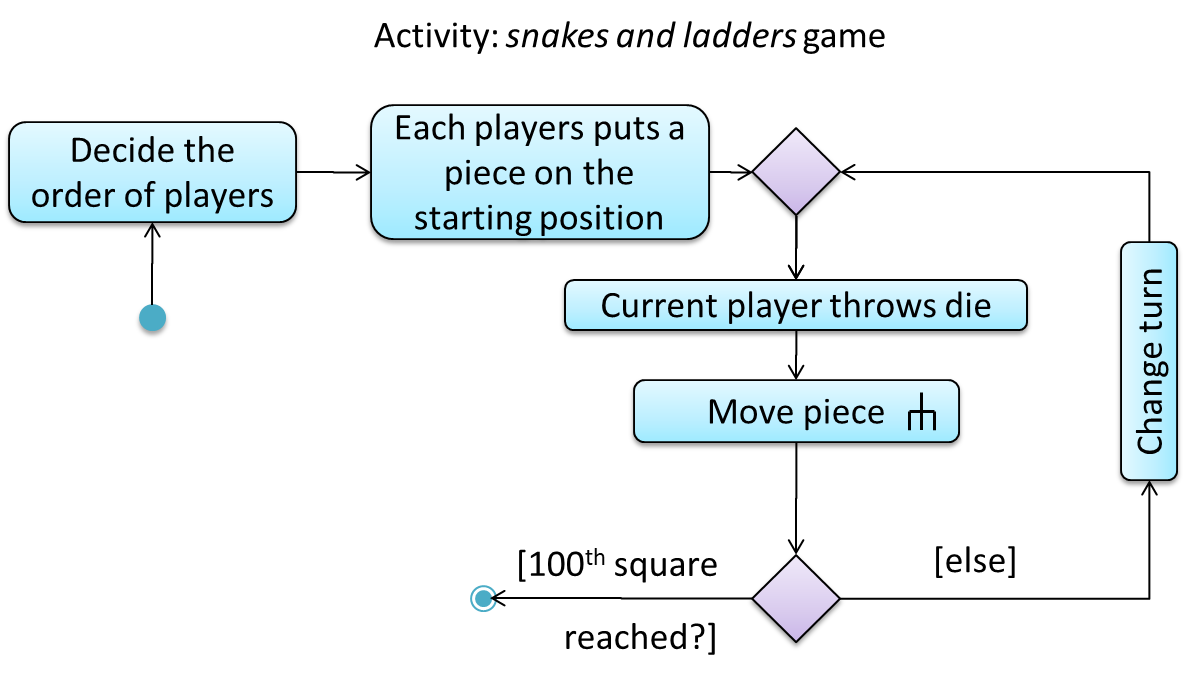
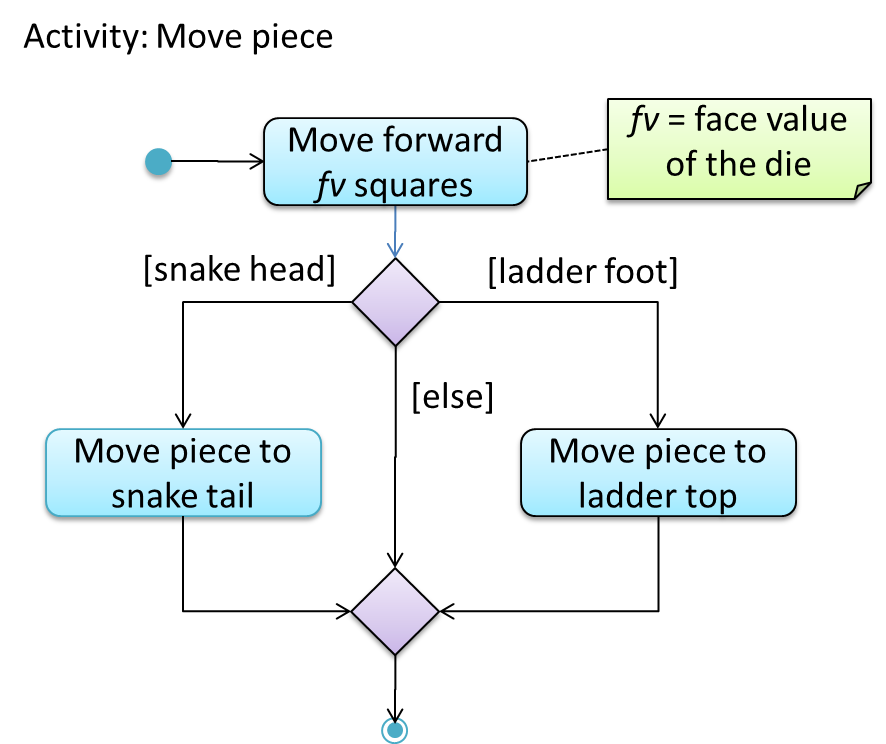
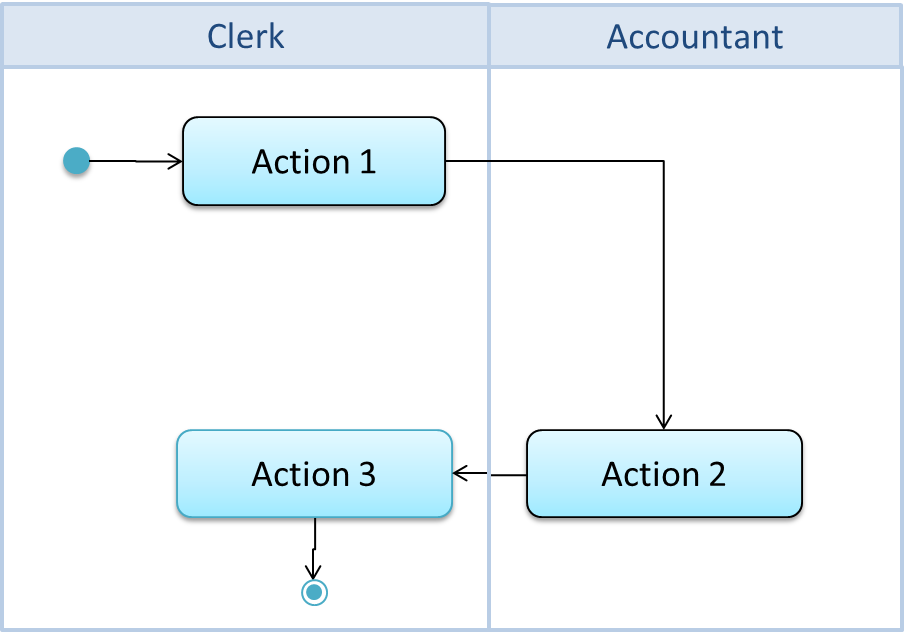
The rake symbol (in the Move piece action above) is used to show that the action is described in another subsidiary activity diagram elsewhere. That diagram is given below.
Can use UML notes
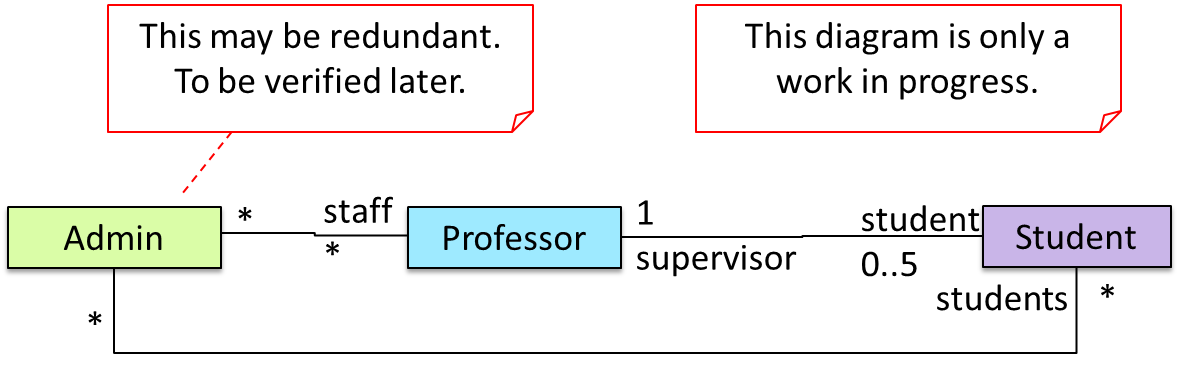
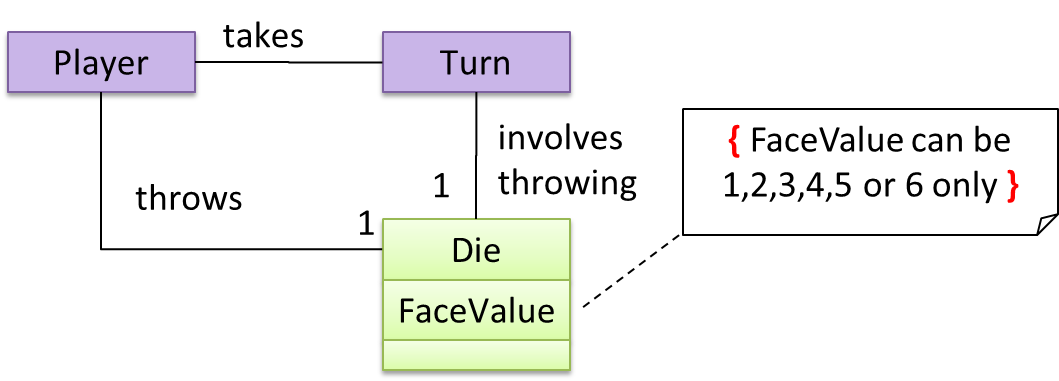
UML notes can augment UML diagrams with additional information. These notes can be shown connected to a particular element in the diagram or can be shown without a connection. The diagram below shows examples of both.
Example:
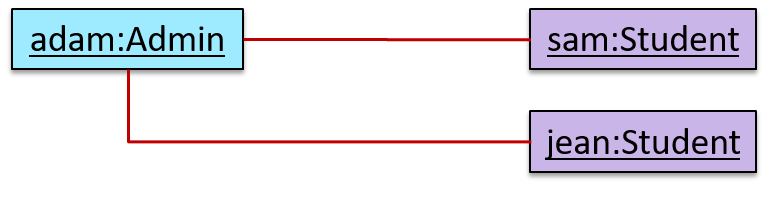
Can distinguish between class diagrams and object diagrams
Compared to the notation for a class diagrams, object diagrams differ in the following ways:
- Shows objects instead of classes:
- Instance name may be shown
- There is a
:before the class name - Instance and class names are underlined
- Methods are omitted
- Multiplicities are omitted
Furthermore, multiple object diagrams can correspond to a single class diagram.
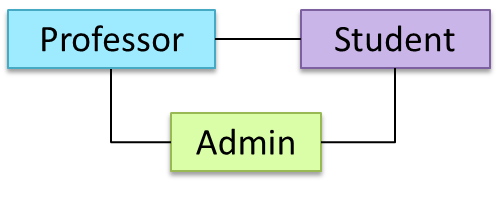
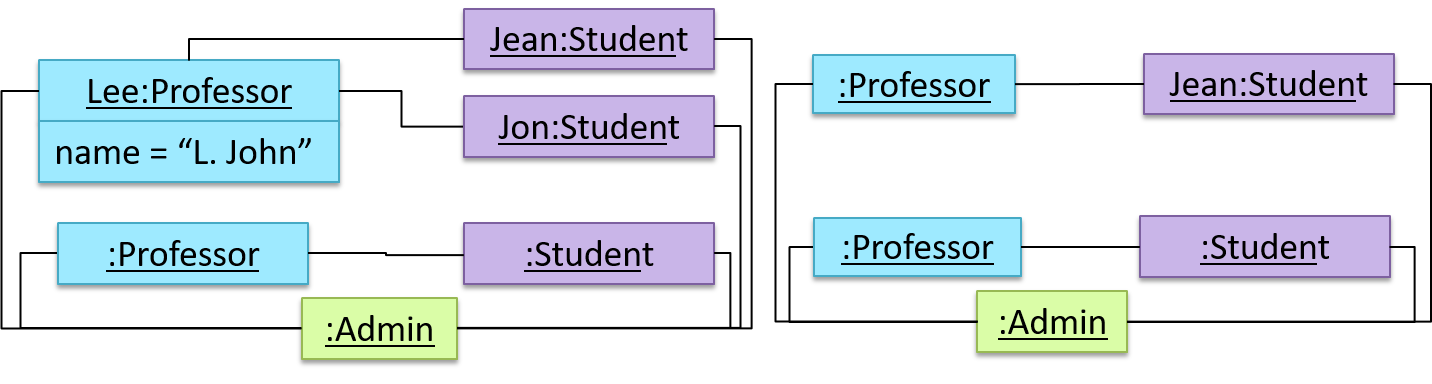
Both object diagrams are derived from the same class diagram shown earlier. In other words, each of these object diagrams shows ‘an instance of’ the same class diagram.
Exercises
Which class diagrams match object diagram?
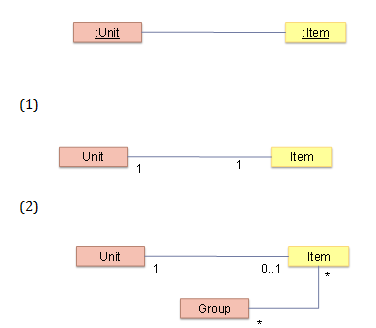
Which of these class diagrams match the given object diagram?
- a
- b
(a) (b)
Explanation: Both class diagrams allow one Unit object to be linked to one Item object.